
ERG Mode Explained: What Your Smart Trainer Is Actually Doing
Learn how ERG mode changes smart-trainer resistance to hold a power target, what cadence to manage, when to shift, and how to start your first workout.
Published
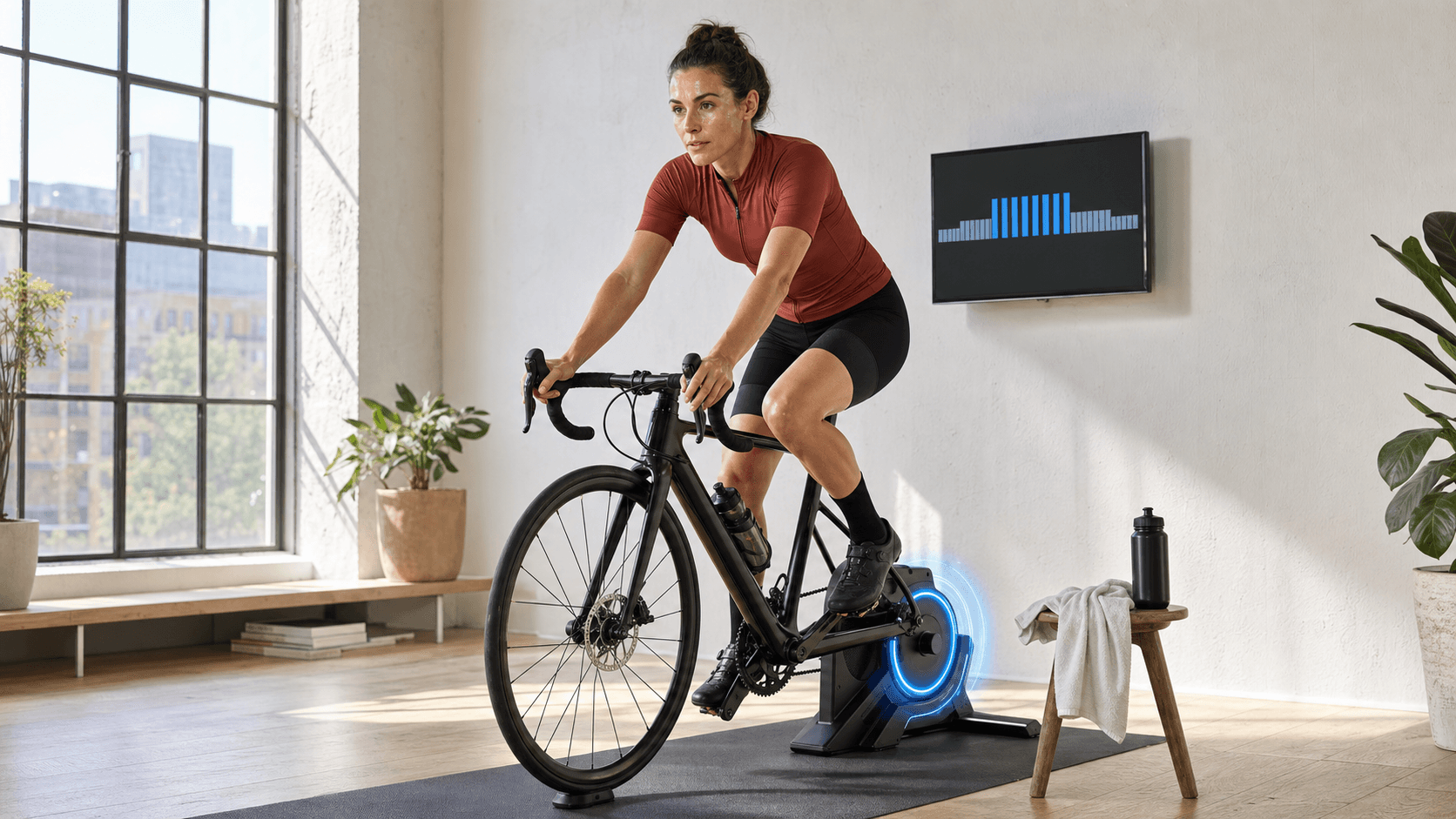
You start an interval at 220 W. A few seconds later, the trainer tightens up. You slow your legs a little. It tightens again.
That can feel as if the trainer has a grudge. It does not. It is doing the exact job ERG mode gives it: holding the workout's power target while you keep turning the pedals.
In ERG mode, let the trainer manage the watts. Your job is to keep a calm, steady cadence.
The simple answer
ERG is short for ergometer. In ERG mode, the workout tells your trainer what power to hold. The trainer changes resistance as you pedal to keep power near that target.
Say the workout moves from 150 W to 220 W. You do not need to shift up and chase 220 W yourself. The trainer senses the change, builds resistance, and settles around the new target while you keep pedaling.
That is the appeal. ERG turns an interval into a simple job: keep the pedals moving smoothly while the trainer handles the resistance changes.
| What changes during the interval | What the trainer does | What you should do |
|---|---|---|
| The target rises from 150 W to 220 W | Adds resistance over a short transition | Keep cadence steady and give it time to settle. |
| Your cadence drops | Adds resistance to keep power near the target | Respond early and bring cadence back before it becomes a grind. |
| Your cadence jumps | Releases resistance to avoid overshooting the target | Do not sprint to chase the number. Return to your chosen rhythm. |
| The workout moves into recovery | Reduces resistance toward the lower target | Keep pedaling and wait for the trainer to catch up. |
| The trainer cannot reach a low or high target in the chosen gear | Runs out of practical range for that setup | Change gear once, then settle again. |
- What changes during the interval
- The target rises from 150 W to 220 W
- What the trainer does
- Adds resistance over a short transition
- What you should do
- Keep cadence steady and give it time to settle.
- What changes during the interval
- Your cadence drops
- What the trainer does
- Adds resistance to keep power near the target
- What you should do
- Respond early and bring cadence back before it becomes a grind.
- What changes during the interval
- Your cadence jumps
- What the trainer does
- Releases resistance to avoid overshooting the target
- What you should do
- Do not sprint to chase the number. Return to your chosen rhythm.
- What changes during the interval
- The workout moves into recovery
- What the trainer does
- Reduces resistance toward the lower target
- What you should do
- Keep pedaling and wait for the trainer to catch up.
- What changes during the interval
- The trainer cannot reach a low or high target in the chosen gear
- What the trainer does
- Runs out of practical range for that setup
- What you should do
- Change gear once, then settle again.
Why cadence matters more than the watt number
In a normal ERG interval, the trainer is already chasing the target. If you chase the watts too, you and the trainer start correcting at the same time.
Watch cadence instead. Pick a rhythm you can hold, keep your upper body quiet, and let the resistance arrive. Wahoo and Garmin both advise riders to keep cadence steady because rapid changes give a smart trainer more work to do.
You will still see small power changes. That is normal. The trainer needs a few seconds to settle. It cannot hit one exact watt the moment an interval starts.
The practical rule is simple: when the target changes, keep turning at the same cadence for a few seconds. Resist the urge to jump on the pedals.
What the trainer feels when you slow down
Power comes from force and pedal speed. When your cadence falls, the trainer has to add more resistance to keep the same power target. When cadence rises, it can release resistance.
That is why a hard ERG interval can go wrong fast if you drift below a cadence you can hold. The lower cadence makes each pedal stroke heavier. The heavier pedal stroke makes it harder to bring cadence back.
If this happens once, do not panic. Ease off. Pause if you need to. Let the trainer release resistance, then start again at a cadence you can hold. If it keeps happening, the target may be too high today. Your FTP setting may also need a check.
This is the beginning of what riders call an ERG lock or spiral. If it happens, reset the ERG lock calmly. For now, remember the early fix: keep cadence from falling too far in the first place.
Should you shift gears in ERG mode?
Usually, no. Pick a gear that gives the trainer room to make the workout easier and harder, then leave it alone through ordinary interval changes.
Wahoo suggests a small chainring and a middle rear cog as a starting point for its trainers. That is a useful start, not a rule. The right gear depends on your bike, trainer, cassette, and workout.
You may need to change gear if recovery never feels easy enough. You may also need one for a planned low-cadence block. Make one change, then give the trainer time to settle. Do not keep shifting to make an interval change arrive faster.
ERG mode does not make the workout easy
ERG removes one decision. It does not remove the work.
If the target is 250 W, you still need to produce 250 W. The trainer simply changes resistance so you do not have to guess which gear or speed will put you there.
ERG is a good match for a session built around steady, repeatable power targets. It gives the rider a clear target and a consistent way to repeat it.
It is less useful for a ride with free accelerations, all-out sprints, or big cadence changes. Use the ride mode that suits the session and your trainer. Do not force ERG into every ride.
Set the target before you start
Many structured workouts use FTP to scale the targets. That means a good ERG experience starts before you press ride.
If your FTP setting is too high, every percentage-based interval will be too high. If it is too low, the workout may feel unusually easy. Use a recent, repeatable test result and update it when your training changes. You can use the MINI WATT FTP calculator to estimate FTP from a supported test.
The goal is not to produce a heroic number. It is to set targets you can execute well enough to repeat training next week.
When MINI WATT fits
MINI WATT fits riders with a Bluetooth FTMS smart trainer who want focused, FTP-based ERG workouts without a virtual world taking over the screen. It holds workout targets and keeps the interval, power, and cadence clear.
When MINI WATT is not the right fit
MINI WATT is not the right fit if your trainer does not have confirmed Bluetooth FTMS support. It is also not the right fit if every ride needs to be a social event, group ride, or virtual-world race. Check the hardware first.
Action plan: Start your first ERG workout in 4 steps
- 1
Confirm trainer control: Check whether your trainer supports Bluetooth FTMS before you build a workout around it.
- 2
Pick a steady first session: Start with endurance, tempo, or a short sweet-spot workout rather than a sprint-heavy session.
- 3
Choose a sensible gear: Begin near the middle of the cassette. Settle into a cadence you can hold and leave the gear alone through normal target changes.
- 4
Let the trainer work: When the next interval begins, keep cadence calm for a few seconds. Adjust the setup only if the trainer cannot meet the range of the workout.
Common mistakes
Chasing the watt number
In ERG, the trainer is already doing that. Focus on cadence and give it time to respond.
Shifting at every interval
A gear change changes flywheel speed and makes the trainer recalculate resistance. Settle in first.
Starting with a huge target
A hard first workout teaches panic, not control. Choose a steady session and learn the feel.
Letting cadence collapse
The trainer can add resistance as cadence drops. Catch the fade early instead of waiting for a full grind.
Treating FTP as permanent
Old or guessed FTP makes every percentage-based target wrong. Retest or adjust when the setting no longer fits reality.
Blaming every delay on a broken trainer
A short response delay is normal, and different trainers react at different speeds.
FAQ
What does ERG mode mean on a smart trainer?
ERG is short for ergometer. In ERG mode, the trainer changes resistance to hold the power target set by the workout as you pedal.
Does ERG mode control cadence?
No. You choose and hold the cadence. The trainer changes resistance to keep power near the target.
Why does ERG get harder when I slow down?
At a lower cadence, the trainer needs more resistance to hold the same power target. That can make each pedal stroke feel heavier.
Should I shift gears during an ERG workout?
Usually no. Pick a sensible gear and let the trainer handle ordinary target changes. Shift only if the trainer cannot reach the recovery or low-cadence targets in the gear you chose.
How long does an ERG trainer take to change resistance?
It is not instant. Wahoo says trainers differ in response time, so hold a steady cadence for a few seconds instead of rushing to correct the change yourself.
Does ERG mode make the workout easier?
No. It makes the target simpler to execute. You still have to produce the power the workout asks for.
What is an ERG lock or death spiral?
It happens when cadence falls below a target you cannot hold. The trainer adds resistance to hold the target. Pause, let resistance release, and lower the target if it keeps happening.
Is ERG mode good for sprint workouts?
It is usually better for steady, repeatable targets. Sessions built around all-out sprints, free accelerations, or large cadence changes can feel more natural in another format.
What FTP should I use for ERG workouts?
Use a recent, repeatable FTP estimate that matches your current fitness. A wrong setting makes every percentage-based target wrong too.
Does MINI WATT support ERG mode?
Yes. MINI WATT provides FTP-based structured workouts with automatic ERG target hold for Bluetooth FTMS smart trainers.
Sources
- Wahoo Fitness Support: A Guide to using ERG mode, accessed 2026-07-27
- Garmin Support: What is ERG Mode Training?, accessed 2026-07-27
- MINI WATT Workouts, accessed 2026-07-27
- MINI WATT homepage, accessed 2026-07-27