
Electronic vs Mechanical Shifting: Pros, Cons, and Is It Worth It?
Electronic vs mechanical bike shifting in plain English. Compare feel, batteries, maintenance, settings, and value before you choose a bike or groupset.
Published
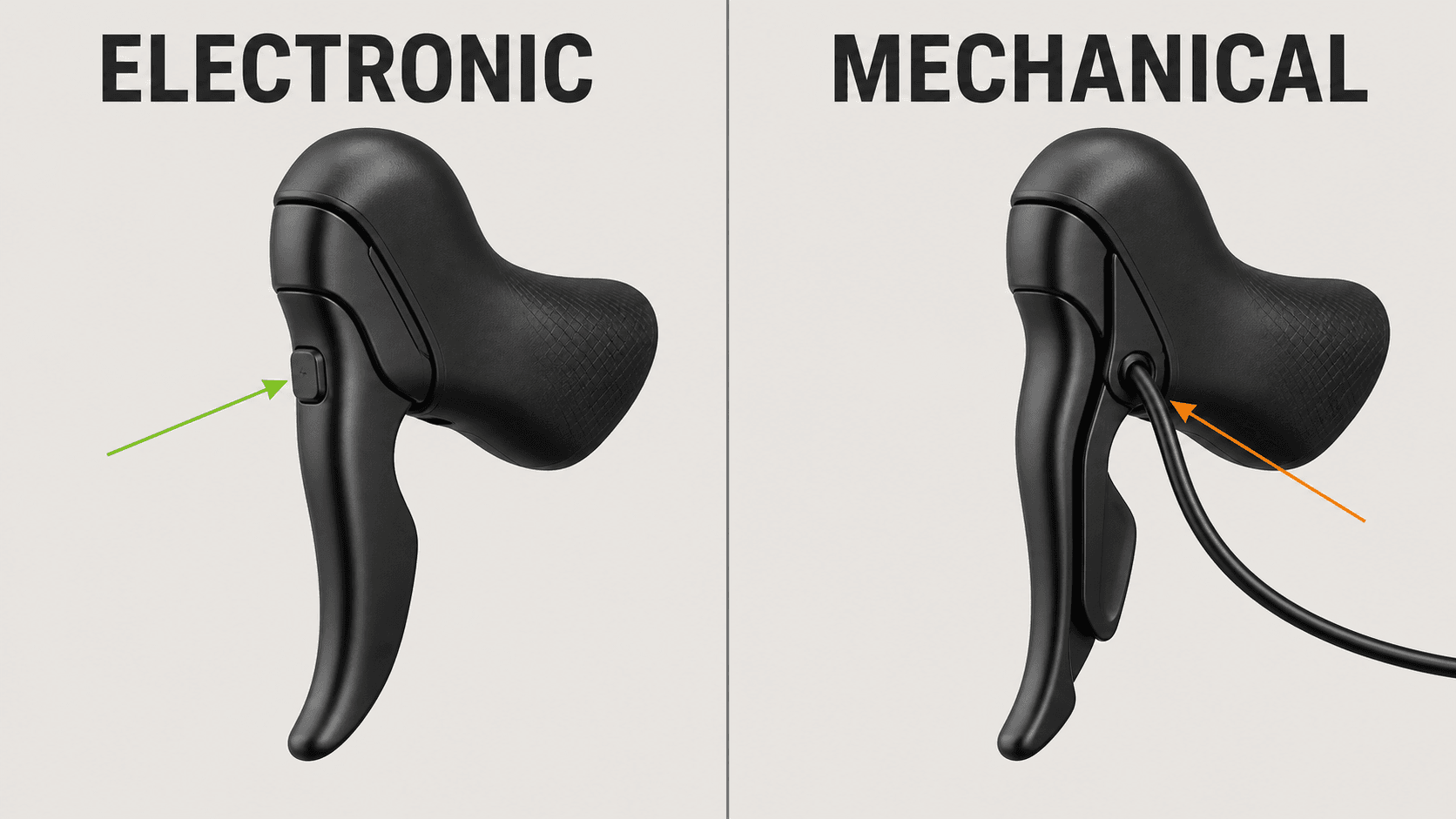
Electronic shifting is worth paying for when you value a light button press and a tidy setup. Some systems offer useful settings too. You also need to keep a battery routine. Mechanical shifting is a strong value choice. It suits riders who want a simple bike, no charging, and a system that is easy to understand.
Neither system adds power to your legs. The electronic vs mechanical shifting choice should come after fit, tyres, gears, and brakes. The best bike is the one you can afford to own and want to ride.
Main answer: electronic vs mechanical shifting
| What matters to you | Electronic shifting | Mechanical shifting |
|---|---|---|
| Shift input | A short button press tells the system to change gear. | A lever moves a cable to change gear. |
| Battery routine | You need to check and charge or replace system batteries. | There is no shift-system battery to manage. |
| Settings | Some systems offer button assignments and shift settings. | The shift behaviour is set by the mechanical parts and their adjustment. |
| Day-to-day care | No shift cable, but electronics, batteries, and exact system support matter. | Cables and housing need normal inspection and service. |
| Best fit | Riders who value a refined control feel and useful settings. | Riders who value simplicity and spending more of the budget elsewhere. |
- What matters to you
- Shift input
- Electronic shifting
- A short button press tells the system to change gear.
- Mechanical shifting
- A lever moves a cable to change gear.
- What matters to you
- Battery routine
- Electronic shifting
- You need to check and charge or replace system batteries.
- Mechanical shifting
- There is no shift-system battery to manage.
- What matters to you
- Settings
- Electronic shifting
- Some systems offer button assignments and shift settings.
- Mechanical shifting
- The shift behaviour is set by the mechanical parts and their adjustment.
- What matters to you
- Day-to-day care
- Electronic shifting
- No shift cable, but electronics, batteries, and exact system support matter.
- Mechanical shifting
- Cables and housing need normal inspection and service.
- What matters to you
- Best fit
- Electronic shifting
- Riders who value a refined control feel and useful settings.
- Mechanical shifting
- Riders who value simplicity and spending more of the budget elsewhere.
How the two systems work
With mechanical shifting, moving the lever pulls or releases a cable. That cable moves the derailleur and guides the chain to another sprocket.
With electronic shifting, pressing a button sends a command to a small motor in the derailleur. The motor moves the derailleur for you.
The outcome is the same: the chain moves to another gear. The real difference is how the command gets there and what you need to look after afterward.
The useful reasons to choose electronic shifting
The control is light
Shimano lists the light, short switch movement as a Di2 benefit. This can feel good when you shift a lot or ride rough roads. It is also useful if you simply prefer a button. It is not a reason to accept the wrong bike fit.
Some settings can be changed
Current Shimano Di2 systems can offer settings through E-TUBE PROJECT. On compatible setups, that includes shift assignments, multi-shift, and synchronized modes. These features can be useful, but they are optional. Check what the exact groupset and lever support before treating customisation as part of the deal.
There is no shift cable
Shimano notes that Di2 does not use a shift wire and includes automatic trim on compatible systems. This removes one normal mechanical-shifting service item. You still need to clean the drivetrain, check the hanger, and replace worn parts. A knock can still damage the bike.
The trade-offs you need to accept
You need a battery habit
Electronic shifting works when the right batteries have charge. The habit is simple: check before a big ride and charge when low. Carry what your system needs. It is still an extra task, so be honest about whether you will do it.
The exact system matters
Do not think of electronic shifting as one standard layout. Current Shimano road Di2 commonly uses a hybrid design. Its controls are wireless, while one central battery is wired to the derailleurs. SRAM AXS derailleur batteries remove without tools and charge on the AXS charger. SRAM's electronic drop-bar shifters use CR2032 coin-cell batteries.
An AXS derailleur battery is easy to carry as a spare. A typical Di2 road setup has one main drivetrain battery to charge. Neither approach is automatically better. Pick the routine you prefer, then read the manual for the actual groupset.
A fault can need different checks
Mechanical shifting problems often have familiar causes. Check cable tension, cable housing, derailleur alignment, the hanger, and drivetrain wear. Electronic systems can add battery level, pairing, settings, firmware, wires, or a damaged electronic part to the list.
That does not make electronic shifting fragile. It means the basic fault-finding path is different. Buy from a shop that can support the system. That is useful if you do not want to do that work yourself.
Does electronic shifting make you faster?
No. It does not add watts, improve your bike fit, or make the wrong gear range right.
It can make a shift feel easier and more repeatable. That is a pleasant improvement, especially on a bike you ride often. But it should sit below fit, tyres, gearing, and brakes when you compare two complete bikes.
Who should choose each system?
Choose electronic shifting when you ride often and like a button-controlled shift. It also suits riders who want the settings their exact system offers. You need to be happy with its battery routine.
Choose mechanical shifting when you want a simpler ownership path or do not want another charging task. It is also a good fit when you would rather spend more on bike fit, useful tyres, or lower climbing gears. Those parts matter on every ride.
A well-adjusted mechanical groupset is not a second-best choice.
Does shifting type matter for road, gravel, or indoor riding?
Both systems work for road and gravel. The route should decide the bike and gears before the shifting type does. Do not give up low climbing gears or the right tyres just to get electronic buttons.
For indoor riding, the smart trainer controls resistance separately from the bike's shifting system. MINI WATT supports Bluetooth FTMS smart trainers for structured ERG workouts and route riding. Electronic shifting is not required.
When MINI WATT fits
MINI WATT fits riders who want to use the bike they enjoy outside for clear, repeatable indoor work. Shifting type does not change whether a compatible smart trainer can run an ERG workout or a route.
When MINI WATT is not the right fit
MINI WATT is not a workshop manual or a drivetrain compatibility checker. Use the groupset maker's documents. A good local shop can confirm batteries, chargers, cables, firmware, axle standards, cassette fit, and replacement parts.
Action plan: choose without wasting your bike budget
- 1
Set the bike priorities first. Confirm fit, tyres, gearing, and brakes before comparing the shifters.
- 2
Name the exact groupset. Do not compare a vague electronic label with a vague mechanical label.
- 3
Learn the battery routine. Ask what charges, what uses coin cells, and how you check the level on that setup.
- 4
Check local support. Look at the cost and availability of the battery, charger, derailleur, chain, and cassette where you live.
- 5
Test the controls. If possible, shift both systems with riding gloves on and choose the one that feels natural.
Common mistakes
Paying for the feature first
Do not trade away fit, tyres, or useful gearing just to get electronic buttons.
Calling all Di2 wireless
Current road Di2 is often a hybrid system, so check the exact bike.
Ignoring the battery plan
Learn how your system checks and charges its batteries before the first long ride.
Assuming electronics need no care
Electronic shifting still needs a clean drivetrain, correct setup, and sensible checks after damage.
Treating mechanical as outdated
A well-adjusted mechanical groupset can be simple, precise, and a very good use of a budget.
Comparing only the sticker price
Check the parts and support you will need after the first season too.
FAQ
Is electronic shifting worth it?
It is worth it if the button feel, settings, and battery routine add enough value for you. It is not worth it if it forces a compromise on fit, tyres, or gearing. Those parts affect every ride.
Is electronic shifting more reliable than mechanical shifting?
Both can work very well when properly set up and maintained. Electronic systems remove shift cables but add batteries and system-specific checks. Mechanical systems use familiar cable adjustment and do not need charging.
What happens if an electronic-shifting battery runs low?
The exact behaviour depends on the system, so use its manual. Check the battery before a long or important ride. Charge or replace it before it becomes a problem.
Di2 vs mechanical shifting: is Shimano Di2 fully wireless?
Not always. Current road Di2 is commonly a hybrid system. Its controls are wireless, while one central battery is wired to the derailleurs. Check the exact generation and bike build.
SRAM AXS vs mechanical shifting: how do the batteries work?
SRAM says its AXS derailleur batteries remove without tools and charge on an AXS charger. Its electronic drop-bar shifters use CR2032 coin-cell batteries. Check your exact components because AXS includes more than one bike category.
Does mechanical shifting need maintenance?
Yes. Cables and housing need inspection and service, and the derailleur and drivetrain still need normal cleaning and adjustment. The upside is that the system is familiar and does not need a shift battery.
Do I need an app for electronic shifting?
You do not need an app for a basic ride. On some systems, an app can help with settings, firmware, or diagnostics. Read the maker's instructions for the groupset you are considering.
Does electronic shifting make a bike faster?
No. It does not create power or replace good fit, useful tyres, or sensible gearing. It can make the shifting experience easier and more consistent for a rider who values that feel.
Is electronic shifting good for gravel?
It can be. Choose it if you like the control feel and battery routine. For gravel, tyre choice, fit, gear range, and the type of terrain should still come first.
What should I compare before buying electronic or mechanical shifting?
Compare the exact groupset, bike fit, tyre clearance, lowest gear, and brake setup. Then check the battery routine, local service, and likely replacement parts. Choose the system you will be happy to own, not the one with the flashiest label.
Sources
- Shimano Di2 Deep Dive, accessed 2026-08-07
- FAQ - Di2, accessed 2026-08-07
- How do I charge eTap AXS derailleur batteries?, accessed 2026-08-07
- How long do eTap AXS shifter batteries last?, accessed 2026-08-07
- MINI WATT home page, accessed 2026-08-07